
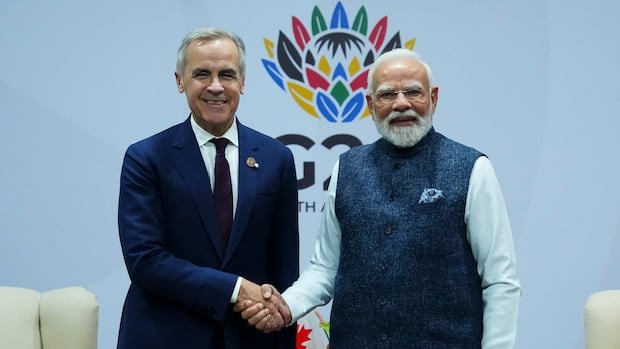
Prime Minister Mark Carney and Indian Prime Minister Narendra Modi have agreed to commence discussions on a new trade agreement known as a Comprehensive Economic Partnership Agreement. Carney mentioned in a social media post that this trade pact could potentially double Canada-India trade to $70 billion.
Acknowledging India as the world’s fifth-largest economy, Carney expressed optimism about the new opportunities this agreement could bring for Canadian workers and businesses. India’s Ministry of External Affairs confirmed this development, stating that Modi has invited Carney to visit India, with Carney’s office accepting the invitation for an early 2026 visit.
This move signals a positive turn in the diplomatic ties between Canada and India following a frosty period triggered by Canadian claims of Indian involvement in the killing of Sikh activist Hardeep Singh Nijjar on Canadian soil in 2023. The recent meeting between Carney and Modi at the G20 summit in Johannesburg further solidified this thaw in relations, marking their second face-to-face interaction since Carney assumed office.
India’s high commissioner to Canada, Dinesh Patnaik, highlighted ongoing trade discussions that have been progressing between the two nations since the G7 summit. Trade talks between Canada and India, initiated 15 years ago, had been limited to specific industries until they were suspended in 2023 due to the aforementioned allegations.
Modi, in a social media post, described his meeting with Carney as productive and emphasized the positive momentum in bilateral ties since their previous encounter at the G7 Summit hosted by Canada. Despite ongoing security concerns raised by the Canadian Security Intelligence Service, both countries are committed to fostering a safe and mutually beneficial relationship.
Carney reiterated Canada’s interest in enhancing trade relations with India, underscoring India’s significance as a key trading partner with immense economic growth potential. The prime minister stressed the importance of maintaining vigilance against foreign interference and highlighted Canada’s collaboration with Indian law enforcement and national security authorities in safeguarding their respective citizens.
Sikhs for Justice, a group advocating for an independent Sikh Punjab, is conducting a referendum in Ottawa, drawing attention to the sensitive issue of “Khalistan.” The decision of the Carney government to resume diplomatic ties with India has faced criticism from the new leader of the Canadian chapter, Inderjeet Singh Gosal, who cited ongoing security threats faced by the Sikh community.
While the referendum has sparked controversy, Patnaik emphasized the perception of foreign interference in India due to such activities conducted on Canadian soil. The meeting between Carney and Modi coinciding with the referendum has prompted discussions on law enforcement matters and public safety, emphasizing the commitment to dialogue and cooperation on security issues.

