
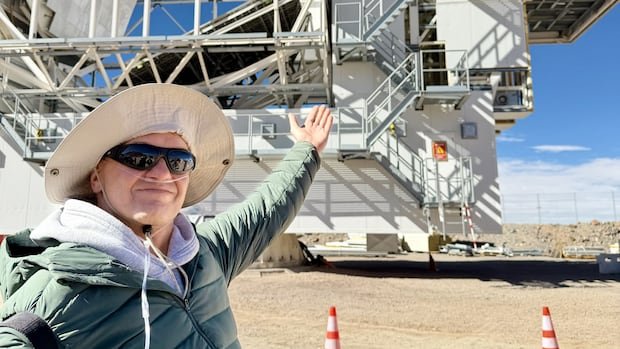
A cutting-edge telescope, pioneered by Canadian researchers, is perched at a high altitude in Chile’s Atacama Desert, promising groundbreaking insights into the universe. Scott Chapman, a respected astrophysics professor at Dalhousie University, expressed the unique opportunity this telescope provides to unveil new cosmic revelations.
At an elevation of 5,600 meters, exceeding the altitude of the Mount Everest base camp, the Fred Young Submillimeter Telescope stands to avoid atmospheric disturbances like water vapor due to its lofty position in the arid desert. Mike Fich, the lead astronomer from the University of Waterloo, highlighted the telescope’s exceptional clarity comparable to space observation but at a fraction of the cost.
With a focus on understanding star and galaxy formation, the project aims to delve into the mysteries of dark energy and dark matter while peering back in time to the universe’s origins. The collaboration, led by Cornell University’s CCAT Observatory in New York in partnership with institutions from Chile, Germany, and Canada, involves multiple Canadian universities, including the University of Toronto and McGill University.
The telescope’s wide field of view, surpassing conventional telescopes, facilitates rapid sky mapping, offering a broader perspective on celestial phenomena. The device accommodates various instrument modules, including cutting-edge quantum sensor cameras, allowing for the detection of submillimeter wavelengths invisible to the naked eye.
With an estimated cost of $40 million, the project entails substantial data processing capabilities to manage the vast information generated daily. The telescope’s construction at extreme altitudes required meticulous planning and logistical challenges, underscoring the dedication of the international team involved in this groundbreaking astronomical endeavor.
Chapman’s innovative cameras, set for installation this summer, are poised to capture groundbreaking data, offering a glimpse into the universe’s evolution. The team anticipates a wealth of scientific discoveries from this pioneering initiative, with the potential to reshape our understanding of the cosmos.

