
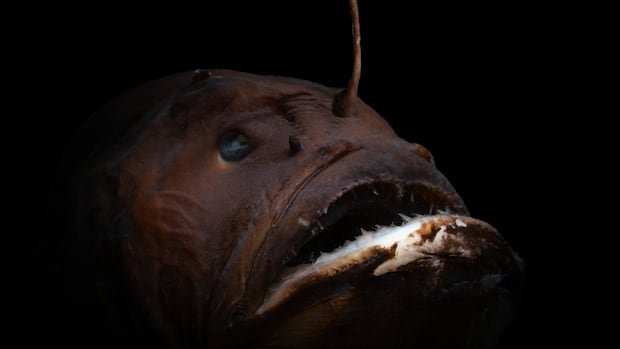
A recent study suggests that female anglerfish may use their iconic forehead appendage not only to attract prey but also as a signal to potential mates in the deep sea. Biologist Alex Maile, the lead author of the study, describes these fish as a mix of beauty and terror.
Published in the journal Ichthyology and Herpetology, the study analyzed DNA from over 100 preserved anglerfish species to explore how their lures have evolved to enhance reproductive success. Marine biologist Milton Love, not part of the research team, finds the dual-purpose lure theory intriguing and innovative.
Anglerfish, known for their appearance in movies like “Finding Nemo,” exhibit a wide variety of lure types, ranging from emitting chemicals to bioluminescence. Maile’s curiosity about the diversity of anglerfish lures led him to collaborate with Matthew Davis to study their evolutionary history and ecological adaptations using computer models due to the challenges of studying deep-sea anglerfish in their natural habitat.
The researchers discovered that the first anglerfish lure originated around 72 million years ago, with bioluminescent lures emerging between 23 and 34 million years ago. This bioluminescence likely facilitated mating in dark waters, aiding males in finding females. Despite being significantly smaller than females, male anglerfish rely on sensory cues and pheromones to locate potential mates.
Bioluminescence as a mating strategy is not unique to anglerfish, as other deep-sea creatures like lanternfish and dragonfish also utilize it. In dragonfish, males have evolved large eyes to spot glowing females. Male anglerfish, upon finding a mate, fuse with the female, providing sperm until eventually detaching from her.
While this mating ritual may seem gruesome, it is a crucial aspect of the male anglerfish’s reproductive cycle. Love emphasizes that this process is the male’s purpose in life and, from a biological perspective, a successful conclusion.

