
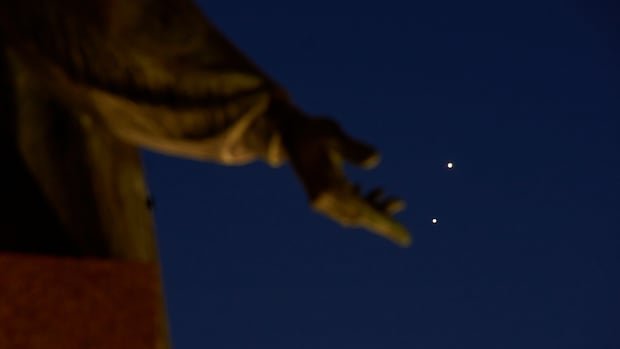
In the western sky after sunset, two bright objects catching your eye are not stars but the planets Jupiter and Venus. Despite appearing close, they are actually approximately 670 million kilometers apart. Venus has been ascending in the sky since early May, while Jupiter has been descending towards the west.
For observers, locating these planets in the west after sunset is easy. Venus, the brighter of the two, will be positioned lower on the horizon. This celestial convergence serves as a vivid reminder that space is dynamic rather than static.
Renowned astronomer, Paul Delaney, from York University’s Department of Physics and Astronomy, expressed enthusiasm about the visibility and movement of these planets in the evening sky. As Venus approaches Jupiter, it will surpass and rise higher in the sky. The two planets will be less than a degree apart on June 8, becoming even closer on June 9.
Such astronomical gatherings are technically termed appulses but commonly known as conjunctions. Observers can track the planets’ movement in the sky leading up to their closest encounter without waiting for the peak event. A clear view of the western sky is all that’s needed to witness this celestial spectacle.
Mercury will also join the planetary duo on June 8 and 9, rising above the sun’s glare. Delaney highlighted that planetary conjunctions occur annually, with varying degrees of proximity and visibility. While Jupiter and Venus align approximately every three years, they may not always grace the evening sky.
An additional engaging observation prior to the conjunction is watching Jupiter’s moons, namely Io, Callisto, Europa, and Ganymede, shift positions from night to night. Sky gazers can witness these rapid movements using tools like Sky & Telescope’s Jupiter Moons tool or night sky apps for object identification.
Witness the upcoming rendezvous of Jupiter and Venus, a celestial event showcasing the beauty and dynamism of our solar system.

