
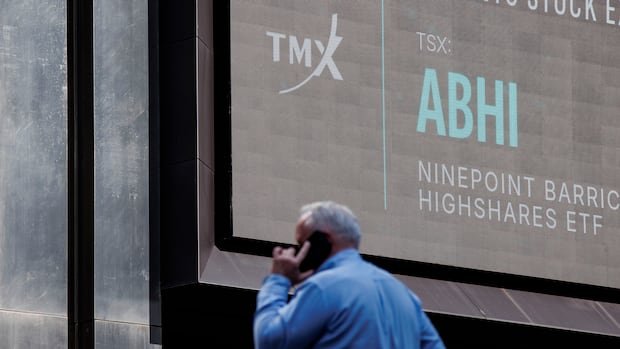
Canadian and U.S. stock markets experienced declines on Friday amid concerns regarding the impact of the U.S.-Iran conflict on interest rates. Dustin Reid, the vice-president and chief strategist for fixed income at Mackenzie Investments, noted that markets were witnessing risk-averse behavior due to higher energy prices and inflationary pressures. This situation has led to expectations of central bank rate hikes, affecting various asset classes, including equities.
The S&P/TSX composite index dropped by 537.57 points to 31,317.41 in Canada, while in New York, the Dow Jones industrial average fell by 443.96 points to 45,577.47. Similarly, the S&P 500 index declined by 100.01 points to 6,506.48, and the Nasdaq composite saw a decrease of 443.08 points to 21,647.61.
Concerns have escalated to the extent that traders have virtually eliminated their bets on potential U.S. Federal Reserve interest rate cuts this year, with some speculating about rate hikes in 2026, a scenario previously deemed improbable. While lower interest rates could stimulate the economy and asset prices, they also pose risks of exacerbating inflation. The current perception among investors is that central banks globally have limited room to implement rate cuts to support their economies.
The May crude oil contract surged by $2.68 US to $98.23 US per barrel. The price of Brent crude has exhibited significant volatility, rising from around $70 US per barrel pre-conflict to a peak of $119.50 US this week. Market fluctuations reflect attempts to assess the war’s duration and its impact on oil and gas production in the Persian Gulf.
Reid anticipates a shift in market dynamics if Brent crude remains at $120 US per barrel for an extended period, prompting a transition from inflation concerns to considerations about global growth and corporate earnings. Despite market challenges, historical trends suggest that stock markets tend to recover swiftly from past geopolitical conflicts, provided that oil prices do not remain elevated for an extended period.
In the Canadian stock market, most sectors registered negative performance, with basic materials exerting the most significant downward pressure. Consumer non-cyclicals was the sole sector in positive territory. The Canadian dollar traded at 72.90 cents US, slightly higher than the previous day’s rate of 72.84 cents US.
Amid the market fluctuations, Reid highlighted the Canadian dollar’s resilience, attributing its performance to the significant safe haven flows observed in the broader U.S. dollar. This stability has enabled the Canadian dollar to fare well in recent weeks, aligning closely with the strength of the U.S. dollar in uncertain market conditions.

