
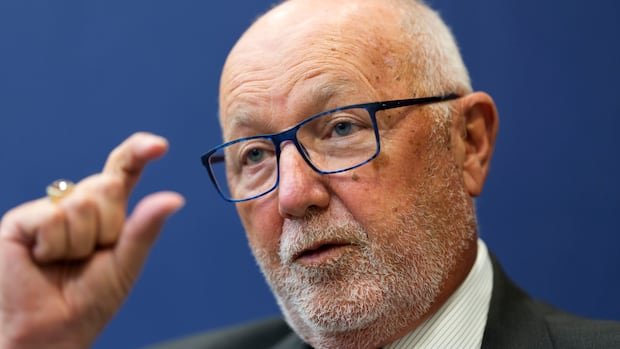
The U.S. representative in Canada reports that after 14 months of trade discussions between Canada and the Trump administration, few issues have been resolved. Nevertheless, he emphasizes that negotiations will continue in the hope of reaching an agreement on the future of CUSMA and addressing other concerns.
During an interview on CBC’s Ottawa Morning, U.S. Ambassador to Canada Pete Hoekstra shared his perspective on the distance between Canada and the United States in resolving trade disputes hindering the renewal of the Canada-U.S.-Mexico Agreement. He acknowledged the ongoing negotiations, stating that President Donald Trump and Trade Representative Jamieson Greer have committed to further discussions in July and August to address outstanding issues.
Despite the prolonged duration of 14 months without substantial progress, Hoekstra expressed optimism about reaching resolutions on key matters. The Trump administration’s recent decision not to extend the existing trade agreement with Canada and Mexico imposes a sense of urgency on these negotiations.
While the deal remains in effect for the next decade with annual reviews, a potential withdrawal by the U.S. could alter the current situation. Hoekstra indicated that the direction and timing of trade talks will be determined by Trump and Canadian Prime Minister Mark Carney.
Regarding Canada’s exploration of alternative trading partners due to uncertainties in the Canada-U.S. trade relationship, Hoekstra highlighted the significance of the tariff-free trade under CUSMA, covering 85% of trade activities between the two countries. He emphasized the predictability of the existing arrangement and the adherence of the U.S. administration to its rules by imposing tariffs on non-CUSMA items.
Acknowledging Canada’s efforts to diversify trade markets, Hoekstra expressed the U.S.’s openness to such initiatives. He underscored the importance of Canada as a potential supplier of three to four million barrels of oil daily, highlighting Alberta’s significant oil reserves.
While emphasizing the importance of Canada as a key oil supplier, Hoekstra mentioned the possibility of exploring other oil sources if an agreement with Alberta is not reached. However, he did not specify alternative sources for oil procurement.
The evolving dynamics in the Canada-U.S. trade relationship and Canada’s strategic shift towards Asian markets for oil exports were also highlighted. Energy Minister Tim Hodgson emphasized the need for Canada to secure diverse oil markets to avoid dependency on a single customer and to maximize revenue by selling at world prices.
In response to Canada’s strategic redirection, Hoekstra acknowledged that while Alberta remains a crucial partner for meeting U.S. oil demands, the U.S. is exploring other global options for oil sourcing in case an agreement with Alberta is not reached.

