
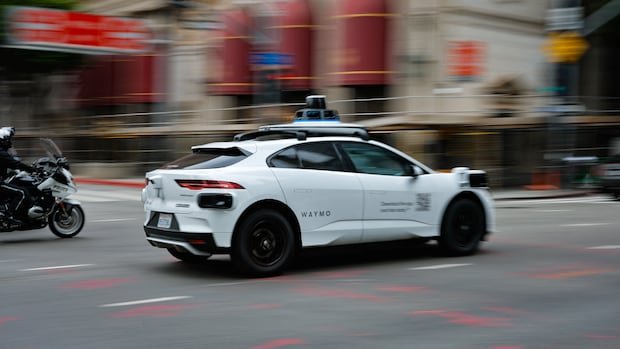
Waymo autonomous vehicles were engaged in 68% fewer accidents compared to human drivers in a span of three years across four U.S. cities, as indicated by recent statistics from the U.S. Insurance Institute for Highway Safety. A study unveiled on Thursday revealed that there were 89 reported crashes involving Waymo in San Francisco, Phoenix, Los Angeles, and Austin between 2021 and 2024. In contrast, there were 901,525 police-documented collisions caused by and involving humans in the same locations during the same timeframe, excluding incidents on interstates and highways.
Steven Waslander, the director of the University of Toronto Robotics Institute, praised the practical application of this technology in real-world scenarios, emphasizing the significance of this achievement in the field of research. Out of the 89 Waymo-related accidents, 72% occurred when the Waymo vehicle was entirely autonomous, with approximately half of them carrying passengers. The study calculated that Waymo covered about 80 million kilometers autonomously, while human drivers traveled 355 billion kilometers in the same areas over the three years.
The research evaluated the crash rates per million vehicle miles traveled, revealing that human drivers had a rate of 4.06 crashes per million miles, whereas Waymo vehicles had a significantly lower rate of 1.28 crashes per million miles, marking a 68% reduction in crash rate. The study, which analyzed Alphabet’s self-driving vehicles, utilized data obtained from law enforcement authorities, Waymo, and federal databases.
According to the U.S. Department of Transportation, accidents involving self-driving vehicles must be reported if the automated driving systems were active within 30 seconds of the incident and led to specific property damage or injuries. Waymo currently operates in 11 U.S. states and plans to expand its services to the United Kingdom and Japan while lobbying to launch programs in Canada.
Eric Teoh, the director of statistical services at the Insurance Institute for Highway Safety, highlighted the importance of considering the types of accidents when interpreting the data. Teoh expressed optimism about the future of autonomous vehicles based on the study results, particularly noting that Waymo’s vehicles are less frequently involved in severe accidents compared to human-driven vehicles.
Despite the promising outlook for Waymo and the autonomous industry, Teoh suggested that governments should make datasets more accessible and comprehensible in the U.S. context. However, there are challenges for Waymo’s entry into the Canadian market, with concerns about job displacement and the impact of the technology on workers’ livelihoods. The differing climate conditions in Canada, especially during winter, present additional obstacles for the expansion of driverless technology into the country.
While collision rates for autonomous vehicles may appear low compared to those of human drivers, instances of technical issues have raised doubts about the reliability of the technology. Notwithstanding, experts acknowledge that these vehicles are continuously learning and evolving. Andrew Miller, the author of ‘The End of Driving,’ emphasized that there should be cautious optimism regarding the progress of autonomous vehicles and their integration into urban environments.

