
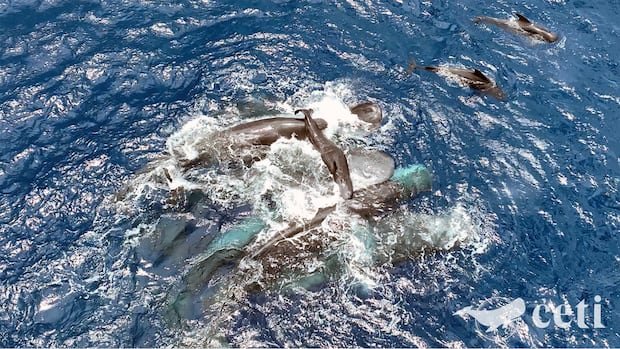
Rare footage capturing a sperm whale’s birth has provided scientists with valuable insights into the behavior of these elusive marine mammals. The video, filmed in 2023, showcases female whales from two distinct family lines collaborating to assist in the birthing process and elevate the newborn calf above the water surface.
This display of coordination is notably unusual in the animal kingdom, particularly outside of primate species like monkeys and humans. Historical records of sperm whale births over the past six decades are scarce, mainly consisting of anecdotal reports or accounts from whaling expeditions.
A recent study published in the journal Science documents this extraordinary event, where researchers observed cooperative behaviors among both related and unrelated sperm whales in aiding newborn calves. The researchers analyzed drone footage to unravel the dynamics of this unique occurrence.
During a research expedition on July 8, 2023, off the coast of Dominica in the Caribbean, scientists studying whale communication were astonished by a group of 11 whales, mostly females, engaging in synchronized movements above and below the water’s surface. The team swiftly deployed drones and microphones to document the spectacle, which included the birth process lasting approximately 30 minutes.
Following the birth, pairs of whales continued to support the calf above the water until it could swim independently. David Gruber, a study co-author from the Cetacean Translation Initiative (Project CETI), described the event as “exceptional.”
The researchers developed software to analyze the collaborative efforts observed during the birth. The remarkable involvement of multiple maternal and non-related female whales underscores the close-knit social structures and support networks within sperm whale groups, reflecting the animals’ solidarity during crucial moments.
Canadian co-author Shane Gero, also associated with Project CETI, highlighted the whales’ collective success in facing challenges and emphasized the significance of their social bonds during vulnerable periods.
Further research published in Scientific Reports delves into the vocalizations and communication patterns exhibited by the whales during the birth. The distinctive sounds and clicks observed suggest a form of communication aiding coordination among the whales during the birthing process.
Gero noted the potential celebratory aspect in the whales’ vocalizations post-birth, drawing parallels to human expressions of joy. These findings raise intriguing questions about the formation of whale groups and their communication mechanisms, shedding light on the whales’ intricate social dynamics.
While the mysteries surrounding whale behaviors persist, the recent discoveries through video documentation offer valuable insights into the hidden interactions and conversations within these fascinating marine creatures. Biologist Susan Parks from Syracuse University expressed excitement about exploring the social lives of whales, emphasizing the significance of such discoveries in unraveling these animals’ mysteries.

