

As Canadian negotiators return home and the 50 percent tariffs from the U.S. are now in effect, the Canadian business sector is assessing the extent of the damage these new duties will inflict.
Leaders from various exporting businesses, ranging from plywood to wine, are expressing concerns that these elevated tariffs will essentially halt their operations with the United States.
However, what is the overall impact on the Canadian economy? Which industries will be the most affected, and what are the implications for employment in Canada? Here’s what you should know.
GDP may decrease by half a percentage point: BMO
The newly imposed 50 percent tariffs target a variety of products, affecting approximately $28 billion in Canadian exports to the U.S.
This amount represents around five percent of Canada’s overall exports to the U.S., which BMO senior economist Robert Kavcic describes as relatively minor in the broader context.
BMO predicts that the 50 percent tariffs could reduce Canada’s GDP growth by half a percentage point, partly due to the increased caution businesses may exhibit towards new investments that are vital for economic expansion.
Kavcic noted that these tariffs arrive at a particularly unfortunate moment, as growth in Canada appeared to be on the rise. Following a slow start to the year, growth has gained momentum in recent months, setting the stage for a strong recovery in the second quarter.
‘Your U.S. market could effectively be gone’
While the overall figures and impacts may seem limited at a national level, specific industries will experience significant hardship due to the concentration of tariffs.
Kavcic remarked, “$28 billion is a relatively manageable figure,” but he cautioned, “I don’t want to minimize the issue because for small or medium-sized enterprises in sectors affected by the 50 percent tariffs, their U.S. market could be virtually eliminated.”
CBC’s examination of export statistics from the U.S. International Trade Commission indicates that producers of electronics and electrical equipment will feel the brunt of the tariffs. In 2025, Canada exported over $4 billion US in electronic equipment that is now subject to these tariffs.
Following electronics, plastics rank second, with $3 billion worth exported to the U.S. last year, and furniture, bedding, and lighting products are not far behind at $2.5 billion. Industrial machinery and paper goods occupy the fourth and fifth positions.
The manufacturing of many of these electronic products, plastics, and furniture occurs primarily in Ontario and Quebec, making these provinces particularly vulnerable to the new tariffs.
Moreover, British Columbia will also face significant consequences, as it is heavily impacted by tariffs on paper and wood products. The newly tariffed items account for over 13 percent of the province’s total exports to the U.S., a proportion higher than any other province.
Significant impact on smaller businesses
Beyond major manufacturing sectors, the newly affected items include a diverse range of consumer goods, such as honey, candles, and hockey sticks.
Kavcic described the selection as “a kind of quirky assortment of goods that have not previously fallen under various other tariffs imposed so far.”
These products are likely to be exported by smaller Canadian businesses, and they may find it easy to substitute with American alternatives.
This situation could disproportionately affect these smaller enterprises, which may lack sufficient financial resources to endure challenging times. The Canadian Federation of Independent Business (CFIB) discovered that 40 percent of its members who export to the U.S. deal with products impacted by the tariffs.
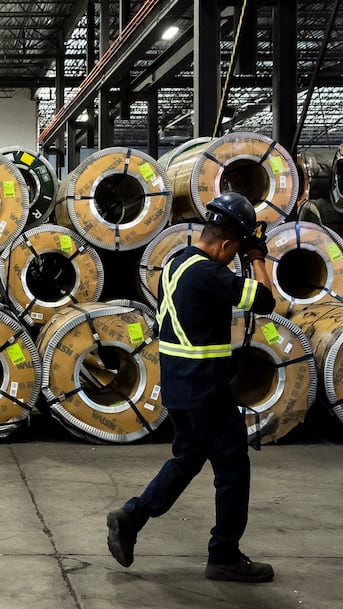
After Canada-U.S. trade talks broke down, U.S. President Donald Trump hit Canada with 50 per cent tariffs on various items. Analysis from economist Trevor Tombe indicates that if the tariffs last, Canada would shed tens of thousands of jobs.
Among the small and medium business owners, 35 percent reported expecting their revenue to decrease by at least half due to the tariffs, while 78 percent indicated that the new duties would render their products uncompetitive in the U.S. market.
Dan Kelly, the president of CFIB, informed CBC News over the weekend that some of the businesses he represents may be “effectively finished” due to the new tariffs.
87,000 jobs at risk: economist
A recent study by Trevor Tombe, an economics professor at the University of Calgary, suggests that the new tariffs could lead to the loss of tens of thousands of jobs in Canada.
He stated that around 52,000 jobs in impacted sectors are at risk, but industries that support those affected by tariffs could also face job losses. Sectors like trucking and bookkeeping services may experience declines, resulting in an additional 35,000 job losses due to this ripple effect.
Tombe explained to CBC News, “All these sectors, essentially across the Canadian economy, are indirectly affected. Consequently, job losses will accumulate in these areas over time.”
In total, Tombe estimates that there could be around 87,000 job losses.
This also implies that job losses will not be confined to Ontario, Quebec, and British Columbia.
For instance, while Alberta exports a small fraction of the goods affected by the new tariffs, it could face about 9,000 job losses due to the presence of industries that support exporters, according to Tombe’s findings.
Uncertainty — the unpredictable factor
Although the primary consequences of the tariffs will be felt in certain provinces and sectors, they introduce a crucial nationwide risk: uncertainty.
Tombe noted, “The uncertainty will likely hinder economic growth more than the tariffs themselves.”
This has been an ongoing issue since U.S. President Donald Trump initiated a trade conflict with Canada approximately 18 months ago, but the aftermath of negotiations has intensified this uncertainty.
Prime Minister Mark Carney has vowed “dollar-for-dollar” retaliatory tariffs, but the specifics of which American products will be targeted remain unclear. With Trump also threatening to impose additional 50 percent tariffs on Canadian automobiles and steel in retaliation, the likelihood of further products entering this retaliatory cycle only heightens the uncertainty.

Prime Minister Mark Carney stated on Monday that U.S. President Donald Trump is acting in a manner anticipated by the government by targeting the automotive sector. ‘What message does that send to workers in Michigan, Ohio, Kentucky, and Alabama who rely on Canadian demand?’ questioned Carney.
Kavcic from BMO expressed, “The primary concern is that Canada retaliates, prompting the U.S. to respond in kind.” He added, “Considering the U.S. economy is ten times larger than Canada’s, can we truly win in a tit-for-tat conflict? Likely not.”
These discussions were also intended to set the stage for broader negotiations regarding the Canada-U.S.-Mexico Agreement (CUSMA) — hence, the failure at this juncture casts a shadow over the future of the trade agreement.
A recent analysis by Oxford Economics, commissioned by the Canadian American Business Council, indicated that if CUSMA were to collapse, over 100,000 Canadian jobs could be lost, resulting in a $271 billion cost to the Canadian economy by 2035.
The existing tensions are likely to be a lingering burden for an extended period, as Kavcic noted, given that the Trump administration has two more years in office and the president’s inclination towards tariffs shows no signs of diminishing.
Kavcic concluded, “The prevailing sentiment seems to be that this relationship is irreparably damaged for the foreseeable future.”
“Thus, if you’re a business, should you defer hiring? Perhaps. Should you postpone business investments? Likely, until this situation is resolved.”

