
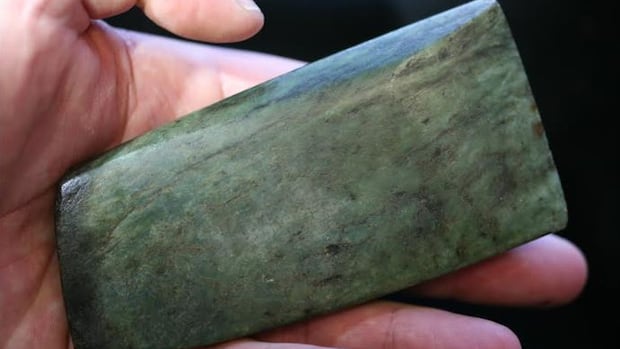
Recent studies examining jade artifacts discovered to the east of the Rocky Mountains provide insights into extensive Indigenous trade networks that spanned pre-colonial Western Canada.
For over 3,000 years, nephrite jade was meticulously hand-polished and shaped into tools such as blades, chisels, and axe heads.
For the central and coastal Salish groups in the Pacific Northwest, these implements — crafted from a remarkably resilient stone available in various shades including emerald green, black, yellow, and white — were vital everyday tools utilized for woodworking tasks essential for their livelihoods.
Nevertheless, some of these stone tools have been traced back to their origins in British Columbia, traveling over the Rocky Mountains to locations in Alberta, Saskatchewan, and Manitoba.
The Archaeological Survey of Alberta, based in Edmonton, conducted a peer-reviewed investigation into these tools, recently published in North American Archaeologist, which included researchers from the University of Alberta, University of British Columbia, University of Saskatchewan, and the Royal Saskatchewan Museum.
Their research indicates that these implements, referred to as stone celts, were highly sought-after prestige objects in the Prairie regions.
Originating in what is now British Columbia, these artifacts were exchanged with Dene and Cree communities situated east of the Rockies via extensive pre-contact trading routes that transcended cultural and linguistic barriers.
The widespread presence of these artifacts indicates that significant social networks existed among Indigenous peoples throughout Western Canada, as stated by Todd Kristensen, regional archaeologist with the Archaeological Survey of Alberta and the primary author of the study.
“By the time it crossed the Rockies around 1,000 years ago, the jade had transformed into a symbol of social alliances and networks — essentially a gift rather than just a practical tool,” he explained.
‘The mystery’
The research aimed to resolve longstanding questions in anthropology. While the use of nephrite by pre-contact populations in British Columbia is well-documented, its occurrences east of the Rockies have received minimal focus, according to Kristensen.
Given the absence of local nephrite sources or crafting evidence in the Prairies, the researchers sought to uncover the origins of these artifacts and their methods of transport.
“In British Columbia, they were utilized to create cedar dugout canoes and various woodworking items,” Kristensen noted. “In Alberta and Saskatchewan, where these jade celts have been found, the context is quite different.
“That was part of the enigma. Why do we find these jade artifacts in a region where it seems they were not needed for practical use?”
The researchers examined 24 nephrite celts identified east of the Rockies over the last 75 years. They verified their mineral composition and provenance through portable X-ray fluorescence, gamma spectrometry, and specific gravity assessments.
The findings confirmed that each item originated from the Fraser River area of British Columbia.
The study revealed that, on average, the celts traveled nearly 850 kilometers from their source, with some having journeyed nearly 1,500 kilometers.
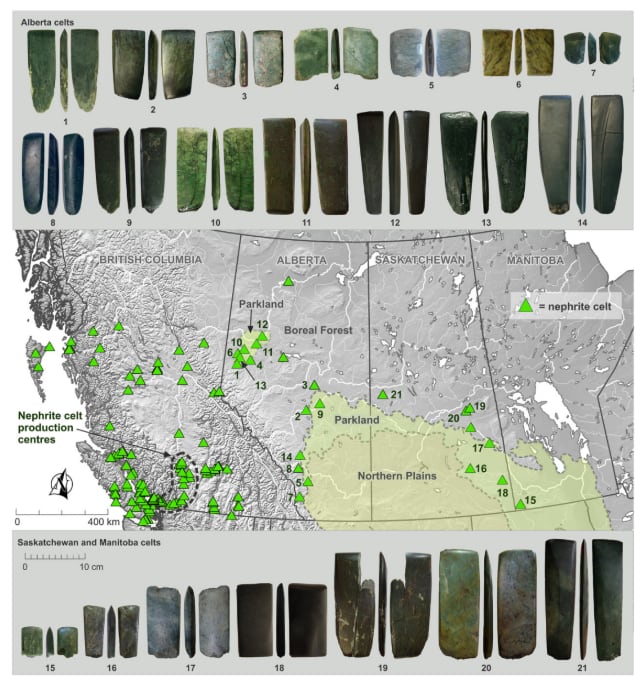
This graphic from the Archaeological Survey of Alberta details all known locations where jade stone celts have been found east of the Rocky Mountains. (Archaeological Survey of Alberta)
The research outlines several potential routes along which these artifacts may have traveled across the continent.
Interior Salish artisans could have traded with nearby Dene groups, who then transported the celts eastward over the Rockies to share with Dene relatives and ancestral Cree communities, as suggested by the study.
The research also posits that Dene groups migrating west from northern Alberta for trade gatherings along the Fraser River might have acquired the celts and taken them back home, or that Salish groups making eastward trips into Alberta’s river valleys may have exchanged goods directly with western Dene communities.
“We believe that Dene migration through the region contributed to a revitalization of relationships that facilitated the eastward movement of jade across the Rocky Mountains,” Kristensen stated.
“Jade might serve as a critical indicator of a new economic relationship that altered the distribution of goods.”
‘Beautiful object’
Creating a single nephrite celt required considerable effort in grinding and polishing. A smaller celt could take over 100 hours to complete, while larger versions might require as much as 500 hours.
“Investing 100 hours into an object imparts significant meaning and value,” Kristensen remarked.
Celts in the Pacific Northwest were often re-sharpened and used as tools for generations. However, those unearthed by archaeologists in parklands and boreal forests, where communities depended more on birch bark and hide structures rather than heavy timber, were noticeably larger and exhibited little wear.
This indicates that the stone celts had transitioned from functional tools to items of prestige as they traveled farther; they became symbols of status.
Kristensen likens them to sentimental pieces that individuals might display on a desk or mantelpiece today.
“It’s a beautiful object, but its true value lies in the relationships that facilitated its journey,” he stated.
Typically, pre-contact peoples are depicted as isolated hunter-gatherers, yet the findings of this study provide a different narrative, according to Kristensen.
“We often view people as merely adapting through hunting and gathering enough tools and resources to survive. However, relationships were equally significant,” he explained.
“This jade study is enhancing our understanding of that aspect.”
Kisha Supernant, director of the Institute of Prairie and Indigenous Archaeology at the University of Alberta, noted that this research challenges the notion of pre-contact Indigenous groups as insular, instead highlighting human connections and the capacity for long-distance travel across the western landscape.
Supernant commended the researchers for their collaboration with Indigenous communities and for integrating their findings within the broader context of pre-contact Indigenous cultures.
“This adds a crucial human element — and that is vital, as archaeology fundamentally seeks to understand past peoples,” she stated.
Kristensen emphasized that citizen science played a significant role in this study, as nearly all 24 artifacts were originally discovered by farmers tilling their fields, rather than through formal archaeological digs.
Looking ahead, he mentioned that the research team intends to engage with Indigenous communities to align their findings with traditional oral histories.

