
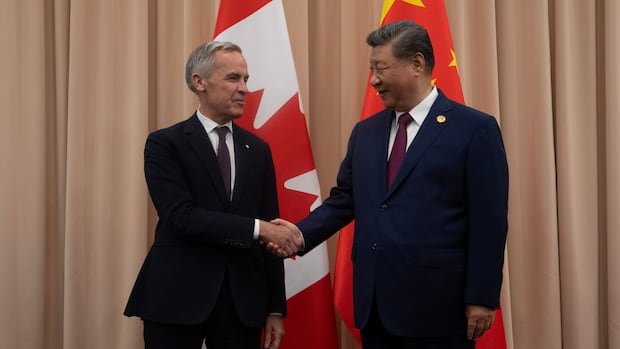
Prime Minister Mark Carney is currently in South Africa attending the G20 summit, an event notably skipped by the world’s largest economy. This move by U.S. President Donald Trump signifies a significant shift in the global order. Canada is now exploring new partnerships with other nations due to the increasingly uncertain relationship with the U.S., with a particular focus on strengthening ties with China while managing associated risks.
Carney has initiated groundwork in this direction, as demonstrated by his recent meeting with Chinese President Xi Jinping during the Asia-Pacific Economic Cooperation summit in South Korea. Despite entering the Chinese market relatively late, Carney aims to double Canada’s exports to non-U.S. countries over the next decade, presenting substantial opportunities for growth.
While China ranks as Canada’s second-largest trading partner after the U.S., accounting for approximately $30 billion in Canadian exports in 2024, this only represents about five percent of the country’s total exports, in stark contrast to the nearly 75 percent heading south to the U.S.
Experts suggest that resolving the trade conflict between Canada and China, such as lifting the 100 percent tariff on Chinese electric vehicles, could pave the way for increased trade opportunities. The ongoing trade tensions have led to counter-tariffs imposed by China on Canadian agricultural products, impacting industries significantly.
In addition to trade, there are prospects for collaboration in research and development, manufacturing, and services sectors between Canada and China. With China’s advancements in technology, partnering rather than competing may be a more viable strategy for Canada.
Soft power initiatives, such as educational and tourism exchanges, can also strengthen ties between the two countries. Canada’s complementary economic relationship with China presents openings for collaboration in various sectors, including education and tourism.
Furthermore, experts emphasize the need for a balanced approach when dealing with China, considering differences in governance, human rights concerns, and cyber interference issues. Crafting a strategic China policy will require thorough consideration of these factors and aligning with China’s expectations for a successful partnership.

