
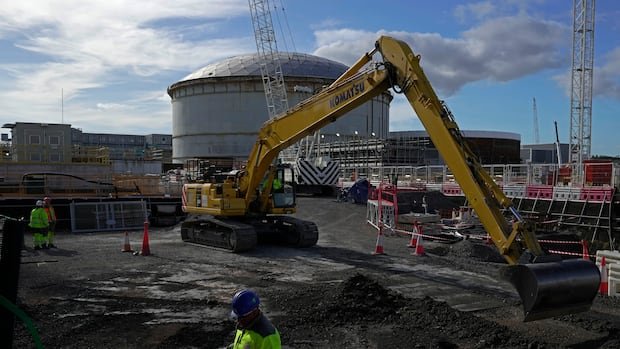
Canada’s Minister of Natural Resources, Tim Hodgson, revealed the government’s ambitious plan to significantly expand the nuclear energy sector, drawing inspiration from a successful project in the U.K. The U.K.’s Sizewell C plant, located in Suffolk, is a £38.2 billion ($72.3 billion Cdn) endeavor, with private investors shouldering 55% of the construction costs.
Hodgson aims to replicate this collaborative investment model to realize Canada’s goal of constructing up to 10 new reactors. Notably, one of the investors in Sizewell C is La Caisse, Quebec’s public pension fund, holding a 20% stake valued at $3.2 billion Cdn.
Securing such investments poses challenges, particularly for risk-averse funds, given the historical budget overruns in Western nuclear projects. For instance, the U.K.’s Hinkley Point C and Finland’s Olkiluoto 3 plants experienced significant cost escalations during construction.
To attract private funding, risk mitigation is crucial. Yrjo Koskinen, a sustainable finance professor at the University of Calgary, emphasizes the need to alleviate investment risks for entities like pension funds. The regulated asset base (RAB) model, employed in Sizewell C’s financing, offers investors early returns during construction and shields them from excessive cost overruns.
While critics raise concerns about nuclear waste and advocate for renewable energy alternatives like solar and wind power, several countries, including Canada, the U.S., France, and Japan, are intensifying their nuclear energy initiatives. Canada’s strong nuclear history in Ontario is seen as a foundation for future expansion, although challenges such as cost overruns persist.
Despite the complexities, large-scale energy projects like nuclear plants have proven beneficial in ensuring energy security and affordability. The experiences of other nations highlight the strategic importance of nuclear energy amid global energy dynamics.

