
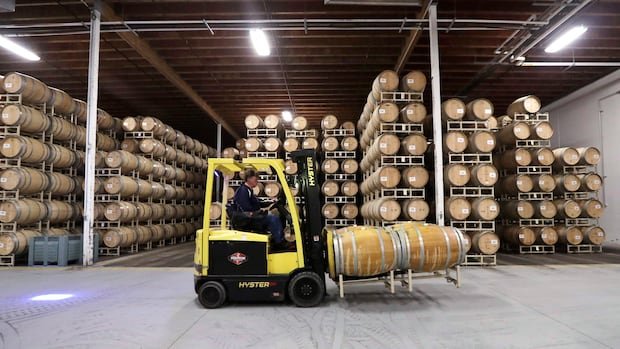
As the Victoria Day long weekend approaches, a significant time for alcohol sales, Canadians are facing the second year without access to American liquor brands. In early 2025, Canadian liquor stores removed American products from their shelves, dealing a heavy blow to the U.S. wine industry. Trade data from the U.S. Census Bureau reveals a staggering $343 million US decline in wine exports from the U.S. to Canada between 2024 and 2025, marking a 77% drop year-over-year. Canada was previously the largest importer of American wine.
Since March 2025, American alcoholic beverages have been conspicuously absent from most liquor stores nationwide in response to tariffs imposed by U.S. President Donald Trump. Only Alberta and Saskatchewan have seen limited sales due to the privatization of liquor stores in these provinces. A recently published report highlighted the U.S. government’s concerns over the alcohol ban as a significant issue for upcoming trade negotiations with Canada, alongside other contentious topics such as supply management and digital taxes.
The U.S. has urged Canada to restore immediate and permanent access to American alcohol products in all provincial and territorial markets. Following Canada, China experienced the next largest drop in U.S. wine exports, decreasing by $69 million US, emphasizing the substantial impact of the Canadian market on the wine trade. Despite this setback, U.S. winemakers have redirected their exports to other countries like South Africa, Belgium, Japan, and the United Arab Emirates, albeit not enough to offset the losses in Canada and China.
Apart from trade tensions, the U.S. wine industry is facing challenges from a shrinking global demand and changing consumer preferences. Ready-to-drink cocktails and seltzers are gaining popularity, while health concerns and generational shifts are contributing to a decline in alcohol consumption. The U.S. trade surplus with Canada, especially in wine, has dramatically reduced due to the trade war’s initiation, though Canada’s wine exports to the U.S. have remained steady and even grown significantly since 2020.
Regarding spirits and beer trade, American liquor exports to Canada have declined while the import of Canadian spirits, including whiskies and ready-to-drink cocktails, has surged. The beer industry has faced a long-term decline predating the trade war, with a rise in microbreweries and consumer preference for local brands over multinational corporations. Steel and aluminum tariffs have also added to production costs for breweries, further exacerbating the challenges in the market.
Despite the economic impacts, Canada has seen a surge in domestic wine sales due to the absence of American alcohol products. The trade war has affected states across the U.S., hitting California’s wine industry and reducing bourbon and whisky exports from Tennessee and Kentucky. As the U.S. approaches a critical midterm election cycle, the future of the Canada-U.S.-Mexico Agreement on trade hangs in the balance, with a pending review this year. The agreement requires all three countries to approve a renewal or signal an exit by July 1, although Canada’s trade negotiator views this as a checkpoint rather than a hard deadline.

