
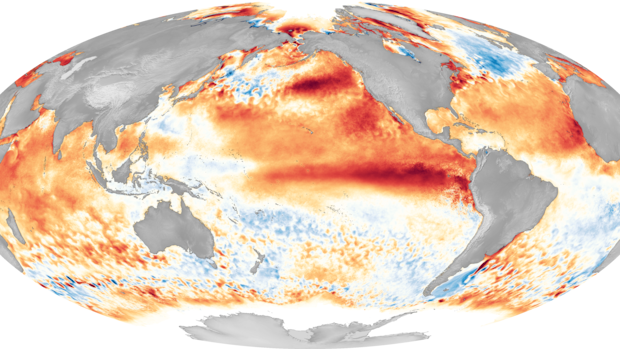
After experiencing La Niña conditions for a year and a half, there are indications that an El Niño event may occur later this year, potentially a robust one that could lead to unprecedented global temperatures. La Niña and El Niño are components of the El Niño Southern Oscillation (ENSO), a natural cycle in the Pacific Ocean. La Niña typically brings cooler temperatures to the region known as Niño 3.4, while El Niño results in warmer temperatures. These phenomena have widespread impacts on weather patterns globally, causing floods in some areas and droughts in others, along with influencing global temperatures.
Currently, there is a La Niña advisory/El Niño watch in effect, with the Climate Prediction Center of the National Oceanic and Atmospheric Administration (NOAA) forecasting a transition to El Niño by summer after a period of neutral conditions. Recent analysis by Zeke Hausfather from Berkeley Earth suggests a strong possibility of a significant El Niño event later this year, with a potential for a “super” El Niño. Past powerful El Niños, such as those in 1997-98 and 2015-16, have had substantial impacts on global temperatures, with ocean temperatures exceeding averages by 2-2.7 degrees Celsius.
Early forecasts indicate a projected 2.4-degree Celsius temperature anomaly, although these predictions are subject to uncertainty during the “spring unpredictability barrier” period. Climate scientist Daniel Swain from the University of California anticipates a strong El Niño based on various model analyses, highlighting the potential for extreme weather events globally. The development of El Niño is expected around June, with peak impact anticipated in November, possibly leading to 2027 becoming one of the warmest years on record.
As El Niño releases stored oceanic heat into the atmosphere, it contributes to rising global temperatures, affecting regional weather patterns. The potential impacts of a strong El Niño in 2027 could include extreme heat, precipitation, droughts, and wildfires globally. The 2015-2016 El Niño brought about record hurricane activity, severe droughts, and disease spread in various regions. With concerns about surpassing the 1.5-degree Celsius warming threshold outlined by the IPCC, continued monitoring of global temperature trends and the influence of El Niño events is crucial in understanding and addressing climate change challenges.

