
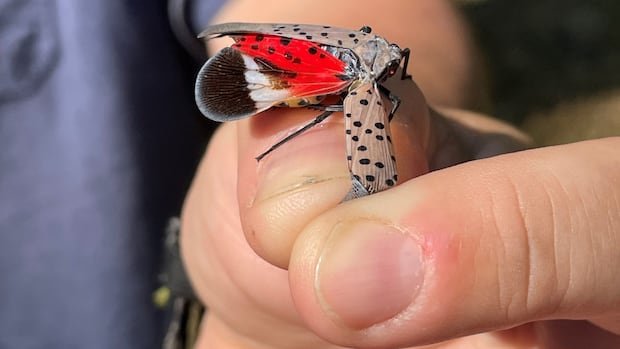
Research conducted at the Great Lakes Forestry Centre in Sault Ste. Marie, Ontario, has unveiled fresh apprehensions regarding an invasive insect steadily encroaching on the Canadian border. Amanda Roe, a research scientist with Natural Resources Canada situated at the forestry centre, disclosed that spotted lanternfly, particularly their eggs, exhibit resilience to extremely low temperatures, surviving as low as -25°C. This discovery suggests that winter conditions may not suffice to deter the harmful pest from establishing populations in Canada, especially in areas where its impact could be most severe.
The destructive spotted lanternfly, originating from Asia, is a sap-sucking insect that utilizes straw-like mouthparts to penetrate trees and plants, extracting sap. It was initially identified in the United States in 2014 and has swiftly spread across the eastern U.S., setting foot in at least 19 states, including Michigan and New York, as well as communities along Lake Erie.
Olivier Morin, a plant health survey biologist at the Canadian Food Inspection Agency, emphasized that the insect feeds on over 100 plant species, with grapes expected to bear the brunt of the impact. In infested regions of the U.S., spotted lanternflies have wreaked havoc on vineyards and agricultural operations, leading to diminished yields and weakened crops. The insects’ excretion of honeydew, a sugary waste, not only coats surfaces but also fosters mold growth.
Amanda Roe remarked that the spotted lanternfly’s preference for consuming commodities important to humans, such as maple trees, is a cause for concern for Canada’s maple syrup industry. The Ontario Maple Syrup Association has been vigilantly monitoring the insect’s movements to assess potential risks to maple syrup production.
While studies have shed light on the insect’s cold tolerance, Roe highlighted the adaptability of invasive species to new environments over time. Human activities significantly contribute to the insect’s spread, with Morin emphasizing that the spotted lanternfly is adept at hitchhiking, often traveling long distances by latching onto vehicles, cargo, and outdoor equipment. The Canadian Food Inspection Agency has intercepted spotted lanternflies on various incoming shipments from the U.S., underscoring the looming threat of their establishment in Canada.
Morin urged individuals encountering spotted lanternflies to capture and report them to the Canadian Food Inspection Agency promptly, as efforts are underway to impede the insect’s spread and mitigate its anticipated impacts upon arrival in Canada.

