
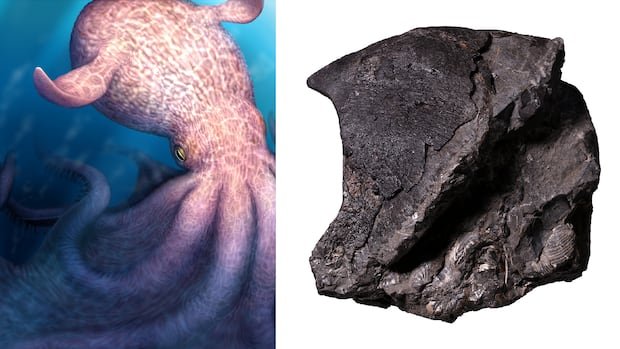
During the Age of Dinosaurs, massive octopuses comparable in size to modern whales roamed the oceans, seizing prey with their enormous tentacles and crushing them with strong jaws, as indicated by fossils discovered in British Columbia and Japan. A recent study published in the journal Science reveals that these sea creatures, resembling mythical tentacled monsters like the Kraken, could reach lengths of up to 19 meters, akin to a sei whale, the third largest extant whale species.
One of the two identified species, Nanaimotethis haggarti, may have been among the largest invertebrates in Earth’s history, according to Yasuhiro Iba, a professor at the University of Hokkaido and the study’s senior author. These octopuses were not only massive but also adept at consuming well-protected prey with hard shells, as evidenced by the wear patterns on their fossilized beaks.
Cameron Tsujita, a paleontology professor at Western University, described Nanaimotethis as “terrifyingly large,” noting a distinctive wear pattern on their jaws that suggests a preference for capturing prey on one side, indicating a level of intelligence. The fossils were found in rock formations on Vancouver Island and in Hokkaido, Japan, with some displayed at the Courtenay and District Museum and Paleontological Centre in British Columbia.
The study’s innovative “digital fossil mining” technique allowed researchers to analyze detailed specimens and confirm that the Nanaimotethis species were finned octopuses, not vampire squids as previously believed. These ancient octopuses lived between 100 to 72 million years ago, making them the oldest known octopuses, raising intriguing questions about the evolution and origins of these intelligent creatures.

