
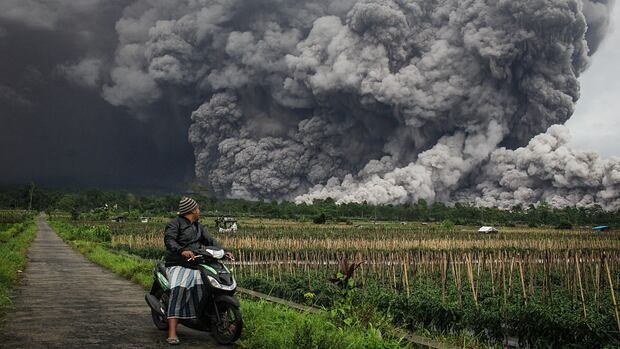
Indonesia’s highest peak on Java island, Mount Semeru, erupted on Wednesday, showering several villages with ash, triggering evacuations, and prompting authorities to elevate the alert status to the maximum level. The volcano in East Java province released scorching clouds of hot ash, rocks, lava, and gas, traveling up to seven kilometers down its slopes multiple times from midday to dusk. A thick column of hot clouds ascended two kilometers into the sky, according to Indonesia’s Geology Agency.
The successive eruptions compelled officials to escalate the volcano’s alert level twice, from the third-highest to the highest level. Fortunately, there have been no reported casualties. Over 300 residents from three vulnerable villages in the Lumajang district were relocated to government shelters as a precaution, stated Abdul Muhari, a spokesperson for the National Disaster Mitigation Agency.
As the volcano’s activity intensified on Wednesday afternoon, the danger zone was expanded to an eight-kilometer radius from the crater. People were warned to steer clear of an area along the Besuk Kobokan River, which the lava flow was following as scorching gas streamed down Mount Semeru’s slopes.
Social media footage depicted a dense ash cloud sweeping through a forested valley towards a river under a bridge. Residents, some covered in volcanic debris and rain, sought refuge in temporary shelters or relocated to safer regions. Reports from local media revealed the challenging rescue efforts to assist approximately 178 individuals stranded at the Ranu Kumbolo monitoring post on the 3,676-meter mountain. The group comprises climbers, porters, guides, and tourism officials, as confirmed by an official from the Bromo-Tengger-Semeru National Park.
Endrip Wahyutama, a spokesperson for the national park, assured that the stranded individuals are safe at the monitoring post, situated 4.5 kilometers from the crater on the northern slope, away from the path of the hot cloud flow moving southeast. Adverse weather conditions and rain compelled them to spend the night there, according to Wahyutama.
Mount Semeru, also known as Mahameru, has witnessed several eruptions over the past two centuries. Despite this history, many people reside on its fertile slopes, as is the case with numerous active volcanoes in Indonesia. The volcano’s most recent significant eruption occurred in December 2021, claiming 51 lives and causing injuries to hundreds in buried villages. The eruption led to the evacuation of over 10,000 individuals, with around 2,970 houses relocated out of harm’s way.
Indonesia, a vast archipelago with over 280 million inhabitants, lies along the Pacific “Ring of Fire,” a region prone to seismic and volcanic events.

