
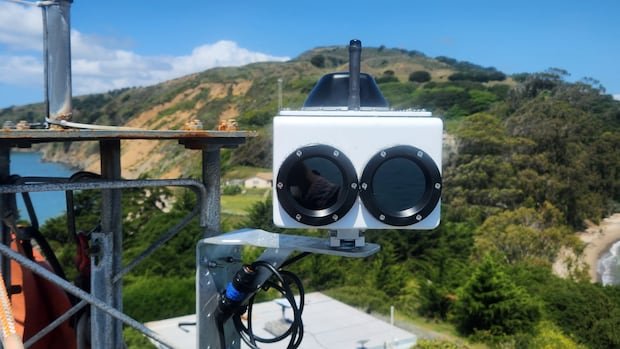
Marine scientists in British Columbia are optimistic that an innovative approach to monitoring whale sightings in parts of California could be beneficial in preventing whale strikes in their region. In San Francisco Bay, a collaborative effort involving scientists, ferry operators, and the public is underway to track whales using a specialized camera system and a dedicated app.
The WhaleSpotter cameras, housed in compact white boxes, utilize thermal imaging technology to monitor whale activity around the clock. These sightings, combined with human observations, are logged in a public app for broader awareness and protection efforts. According to Daniel Zitterbart, the chief scientist at WhaleSpotter, increasing surveillance on the water can enhance whale conservation.
While some WhaleSpotter cameras are already operational in British Columbia, they are currently limited to land-based locations, such as Angel Island, restricting their range for whale detection to approximately two nautical miles. The importance of tracking marine mammals is underscored by the rising concern over vessel strikes in British Columbia, with documented incidents involving humpback whales and orcas in recent years.
In San Francisco Bay, the WhaleSpotter cameras are integrated with the Whale Safe app, allowing various stakeholders to monitor whale sightings collaboratively. Douglas McCauley, the director of Benioff Ocean Science Laboratory, emphasized the community-driven nature of this initiative as a valuable resource for public service.
In British Columbia, access to the camera data is currently limited to approved commercial mariners through the Ocean Wise whale report alert system. However, there are calls for broader public access to enhance whale protection efforts. Thomas Hall from San Francisco Bay Ferry highlighted the potential of ferry-mounted cameras to provide valuable insights into whale behavior over time, aiming to adjust routes based on observed patterns.
Looking ahead, there are hopes for expanding the use of detection devices on B.C. Ferries routes, particularly in areas known as “humpback highways,” to mitigate the risk of whale strikes. As concerns over ship traffic and climate change impacts on whale behavior grow, collaborative conservation efforts are increasingly critical. Sean Brillant, a conservation biologist at the Canadian Wildlife Federation, stressed the global significance of addressing vessel strikes and the necessity of cross-border collaboration in ensuring the safety of whales.
Efforts to learn from the successful whale monitoring practices in San Francisco Bay could serve as a valuable model for British Columbia’s whale conservation strategies.

