
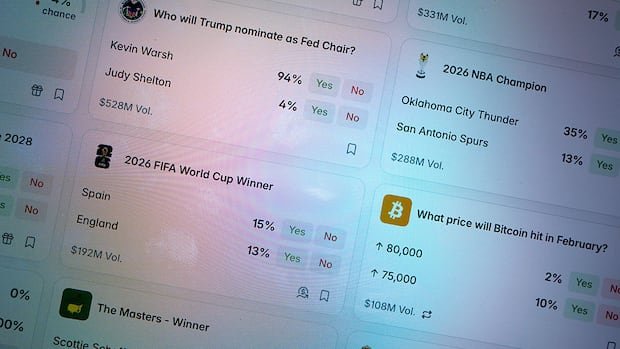
A recent study suggests that the odds may not be in favor of individuals looking to profit from prediction markets as they enter the Canadian market. Platforms like Polymarket and Kalshi offer users the opportunity to bet on real-world events through buying and selling contracts, limited in Canada to events related to economic indicators, financial markets, and climate trends. For instance, current contracts on Polymarket include speculations like “Will there be a Bank of Canada rate hike in 2026?” and “Will any month of 2026 be the hottest on record?”
In contrast to traditional gambling venues, prediction markets do not have a house to bet against. Instead, users compete against each other, and the platforms generate revenue by charging small transaction fees. A recent paper authored by researchers from Yale University and London Business School reveals that only a small percentage of Polymarket accounts, deemed “skilled traders,” consistently achieve profits and accurate predictions, with a larger number of losing traders funding these profits.
As prediction markets gear up to expand in Canada through Wealthsimple’s collaboration with Kalshi, experts emphasize the importance for Canadians to understand their competition. According to Roberto Gómez-Cram, co-author of the paper and assistant professor of finance at the London Business School, participants need to possess sophistication and avoid casual betting to navigate these markets successfully.
The study, which has not undergone peer review, analyzes data from Polymarket, encompassing $13.76 billion US in trading volume across 1.72 million accounts. It indicates that nearly 70% of the trading volume originates from less-skilled traders, implying that the successes of the market are largely funded by errors made by the majority of traders. The system thrives on a substantial trading volume to operate effectively, with more users engaging in contract positions resulting in increased platform funds and subsequently higher earnings for skilled traders.
The research underscores that skilled traders exhibit attributes such as rapid news processing, consistent trading experience, and sometimes advanced programming knowledge. These traders employ algorithms not only for trading but also for information gathering and predictive modeling. They follow a systematic approach that requires time to develop, employing computer programming skills and leveraging data from various sources to trade against crowd errors.
Prediction markets have witnessed a surge in popularity, with monthly trading volumes escalating from $100 million US in 2024 to $24 billion US in 2026. Consequently, financial firms are actively recruiting skilled traders to navigate these markets effectively. Hedge fund Tyr Capital is among the firms seeking prediction market traders with expertise in finance and economics to trade products linked to central bank decisions and macroeconomic events.
There is a growing concern among experts that individuals may perceive prediction markets as an easy route to financial gain. Luis Seco, a professor from the University of Toronto, advocates viewing these markets as entertainment rather than a reliable income source. He warns against underestimating the competition posed by professional hedge funds, advising caution and highlighting the dominance of major players in these markets, ultimately cautioning retail investors about potential losses.

